January 2026-- Call any time about these guitars or what's coming up. I've become horrible about answering my landline. If we decide to work together, I'll give you my cell. Emails get buried by spam within an hour of their arrival, but if I don't answer within a day, please please please send again.
310-522-9596
-Micro bevel at the cutaway
-Traditional koa rosette
-16" lower bout
-25.4" scale length
-Nut: 1 25/32"
-String Spacing: 2 5/16"
-Cosmo Black Gotoh 510s
-Flight Case (Call for options.)
-The neck is modified oval
The last coco and adi Model F I built made a lot of people smile, so I decided to do it again.
It just so happens I have many really killer sets of cocobolo. My tops have been stored for so long they are starting to show age, and that's a very good thing. People might chase after some of the modern tricks like cooking or over thinning the wood, but I planned for age to do what age has done since the dawn of lutherie. There is nothing like wood that has been seasoned for what turns out to be 48 seasons. I fall back on tradition any time I can.
This guitar is really responsive. I believe it's louder than many of my guitars have been, but as the other guitar newly listed gets a few weeks on it, maybe it's perception. It's the responsiveness that matters most, and it has that no matter how you measure it. It has the thick mids of cocobolo, the bass distinctly rumbles. The trebels are balanced.
This guitar was with me at the Artisan show and was praised by players. Does that count? People are always so nice. It also survived the ordeal with no scratches.
Master German Spruce top, way too perfect for a burst.
Ebony bindings
Kathy's riff on Jimmi's Klimt rosette
Matching back strip inlay
Ebony headstock overlay with koa signature
15" lower bout
25.4" scale length
Nut: 1 25/32"
String Spacing: 2 5/16"
Cosmo Black Gotoh 510s
Flight Case (Call. I have some great choices on hand.)
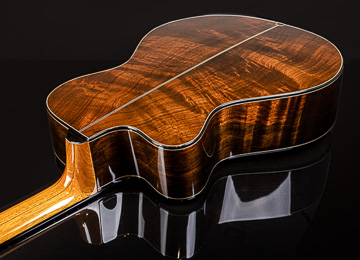
This Brazilian is my favorite thing: Plenty of figure with an over all calm, straight grain that I personally believe
is the wood that ages best in every way. I'm coming to the end of my Holy Grail stash. Each of the sets I have left are very special and completely different in appearance. When this one is gone, it's just gone.
This is a beautiful guitar. I don't know what possessed me to risk a sunburst on a Brazilian guitar, and it's a little bit like bringing sand to the beach, but I really like this rosette with a bursted top. The top was perfect in every way, so the burst is an enhancement and is transparent all the way to the edge. The photography light plays tricks on it. In real life the colors are beautiful violin colors. In the camera it varies, and none of it looks as good are real life.
It loves DADGAD. Of course it loves DADGAD. I was finger picking some Irish tunes. The middle voices popped right out. It sounded lush on some classical.
Brazilian and European spruce are having their usual perfect love affair. The basses are fuller than they deserve to be on such a comfortable guitar. The trebles are firm and lovely. The balance is all the way across. Or it promises to be. It's so young, changes can happen by the hour, and I have learned to trust what I hear over all. I did some recording on it, and the guitar behaved perfectly. It's too bad because the guitar sounds great, if it weren't for the wind tunnel sounds. I have some work to do to make the room suitable.
The neck is a comfortable modified oval. The frets and set up are perfect and ready to ship, but that won't stop me from nit picking one more time before it goes out.
TONE! Tone for days. Beautiful depth and maturity. My lifetime goal? Check.
Dark but articulate, sparkling and thick, powerful treble without screwing up the balance. Growls at the bottom. Check, check, check and check. I'd take all the credit for it, but time has done a good bit of work here. I just built a guitar that would live long enough to sound this good. From all appearances, it will live much much longer.
I'm not gonna lie. There were a couple of aesthetic misses on this guitar. It has a MOP signature and green ab trim on the top and rosette. I know... people do that. I wish I hadn't. There is a rosette of abalone inside koa. I would never do a rosette like that now without generous purfling lines to set it off. The abalone backstrip has fine red purfling lines to match the red laminations of the neck. The headstock overlay has black, white and red laminations for show along the edge. Inexplicably I didn't pick up the red anywhere on the top. In my defense, in those days, I frequently found the cereal in the fridge and milk in the pantry. I was still working full time at the repair shop. There were kids. And also, no one has ever accused me of being a good salesman. I always point out any warts.
It came back to me in need of quite a bit of work. There was finish checking on the top which I took care of. The repairs are good, very minimal telegraphing. You can zoom on images of the belly just under the bridge. There are slightly dark lacquer lines, but they are fading. The top will even out over time. There are a few super minor little pecks. Just enough to show her age. It has a Tor-tis pickguard. I changed out the old locking Gotohs standard 510's. Gotoh made a mistake marketing them for acoustic, but they stood behind their product and provided replacements for two dozen sets. I like them and their tuners. There is a Baggs under that saddle which I haven't tested yet. I can leave that or install a K and K. The frets and neck are all good. The intonation is right. The dome of the top is textbook.
The neck is a little deeper, more like a D shape. It's narrower than my norm, but I find it very playable because the shape guides your hand to a relaxed grip. I typically like wide necks, but this shape works for me. The right hand spacing is a bit more narrow than most fingerstyle players like, but if you like narrower necks, cross over to flatpick, or do hybrid picking, it's perfect.
Please click on the image to open a whole page of detail shots.
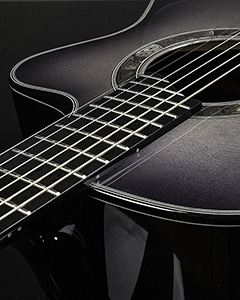
Beautiful Black Ebony
Master German Spruce Top
Ebony bindings and bevel
Black, White purfling
Micro bevel at the cutaway
Black Mother of Pearl Jimmi rosette
15" lower bout
25.4" scale length
Nut: 1 25/32"
String Spacing: 2 3/16"
Cosmo Black with Ebonoid buttons Gotoh 510s
Flight Case (Call)
This guitar features small sound ports in the top of the guitar. Now, before you worry about whether the girl knows what she's doing, or not, I do. Where they are positioned, they have zero effect on the structure of the guitar.
As for the tone, this is exciting! With all ports open, it sounds like a ported guitar, but much more refined. Ports make tone more "coarse" to my ears, which is my main objection to them in general. This placement gives a little boost to the treble and diminution of compression that people seem to like about ports. You can hear the difference from the player's position, but it does not boost the volume to the same extent to the player's ear. I don't find that to be a problem, I prefer to know that what people are hearing from the other side of the guitar is close to what I'm hearing.
The amazing and generous Pete Bradshaw did something like 20 recordings with various combinations of open and closed ports. We used corks to do it. (Some attendees of previous Healdsburg Guitar Festivals may remember the experiment by Alan Carruth with corks and ports all on the side of the guitar.)
What the recordings showed is that, kind of obviously, there was the most difference between completely blocked ports and completely open ports. My favorite in the recording is to leave one port open, but not the largest one.
You will be able to continue the experiment if desired, or I will veneer the back of the ports that I choose. If you take the guitar and find that you have a definite favorite, and you want it made permanent, I can make the change at any time.
The beautiful black burst is by Addam Stark, and I do believe he does the most tasteful bursts in the community. It shimmers in black with purple and blue and brown in the changing light. The ebony is very black with some lighter grain lines that popped with the studio light, but are hard to see in normal light. This guitar has my usual neck with a relaxed right hand and modified oval neck carve. The German spruce top has the warmth and bloom that we expect of a good German top.
Please click on the image to open a whole page of detail shots.
Exquisite Brazilian
Master Swiss Spruce Top
Ebony bindings and bevel
Black, White and subtle dark Green purfling
Micro bevel at the cutaway
Black Mother of Pearl Jimmi rosette
16" lower bout
25.4" scale length
Nut: 1 25/32"
String Spacing: 2 5/16"
Cosmo Black with Ebonoid buttons Gotoh 510s
Flight Case (Call)
This guitar has my usual neck with a relaxed right hand and modified oval neck carve. The Swiss Spruce is from the vendor who likes to call it Moon Spruce.
I got it before it got that name, and I have some of the finest around. The dark line down the center is because of the long time storage. The aging of my tops has gone on so long I can't always sand through to white. Rest assured... the rest of the top will catch up fast. Very fast.
The guitar wasn't around long enough to get it to Pete for a demo.
Please click on the image to open a whole page of detail shots.
Gorgeous Madagascar Rosewood
Sinker Redwood Top
Ebony bindings and bevel
Black, White and rich Blue purflings
Micro bevel at the cutaway
Jimmi's Paua abalone rosette
15" lower bout
25.4" scale length
Nut: 1 25/32"
String Spacing: 2 5/16"
Cosmo Black Gotoh 510s
Flight Case (Call for options. I sometimes have extra choices)
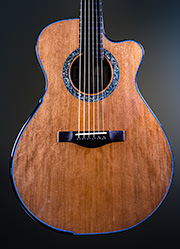
Do you know the story of the sinker redwood? From the time of the Gold Rush until early last century, Humbolt County California had a massive population boom. After the gold dried up, there were plenty of men seeking work. The redwood trees were felled to the point that conservation efforts were called for, and the rush for redwood started to peter out after about 1915. Before it did, there were so many logs floating down the river to the mills that they sometimes jammed up, got water logged and sank. I've been told that in some places a drill comes up with nothing but redwood for twenty feet at the bottom and that in the day, you would walk the river on top of logs. A hundred years later, enterprising people used diving gear to reach the logs, anchor a chain to them, anchor the other end at the shore and wait for the current to eventually float the logs.
These logs were the holy grail of redwoods: old growth, tight grained, straight, gorgeous. And in the real world? It turns out they weren't really that good for construction. Saldy, they split so badly, grape stakes was all that came from a lot of it.
The magic of a century at the bottom of the river is that the wood was preserved, mineralized, strengthened and stained. Some are dramatic and some are more sedate. This set is beautiful, well structuted, more uniform in color, and quite happy to be a guitar.
I love Maddy so much I named a puppy Maddie. I loved her too. This is what I look for: Pretty grain that is as straight as possible. Figure is a plus, but only if it is straight grained. My guitars are not the wildest ones out there... they are built for good structure.
Please click on the image to open a whole page of detail shots.
Unbelievable Madagascar Rosewood
Fine German Spruce Top
Ebony bindings and bevel
Black, White and fine red purflings
Micro bevel at the cutaway
Dyed maple fingerboard inlay with paua abalone dots
Paua abalone rosette
Lightly tinted
15" lower bout
25.4" scale length
Nut: 1 25/32"
String Spacing: 2 3/8"
Gold/Ebonoid Gotoh 510s
Hoffee carbon fiber flight case in red to match the theme
This is a really good guitar. The tone is warm and round and developing nicely. It has a relaxed right hand with a modified oval neck carve. The German spruce top is about as flawless as I've seen and the Madagascar is to die for. I've had very few sets like this in my career, they don't come along very often.
There's a story. There are often stories when a builder takes the time to build a guitar that isn't preordered.
I lost my beloved dog Maddie in June 2022. There is a video on my Facebook page. My dogs come up frequently in my workshop pictures. Maddie even ended up in Acoustic Guitar Magazine! Her favorite days were work days, chilling under a workbench, chawing on a bully stick. Any other day spent at home, she might be anywhere, but on shop days, she was always right there with me.
In the weeks following the loss of her, I let myself wallow. I made the video, I tried my hand at colored pencil (it actually came out okay... but it's still bad art). After that, I really needed something sunny and happy to think about. The inlay is just a happy little squiggle with one Easter egg: seven little suns for her brief seven years.
I spelled Maddie's name with all the girly letters, and I've always nicknamed the wood with a Y. Over time the reason for the inlay will fade, and being made of dyed maple, the inlay will mellow and fade as well. Time is a good thing, especially for guitars. Especially for this story.
I have paired it with a deep and gorgeous red Hoffee flight case. I think it looks great. If you don't like that idea, I have other choices on hand.
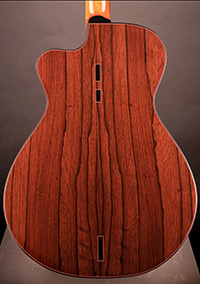
Beautiful, straight, richly colored cocobolo rosewood back and sides.
A tonal MONSTER.
Previously exhibited, but carefully guarded, this guitar received first place at the Designs in Wood Exhibit in May 2018. The private emails from the event managers well more than complimentary.
This guitar has amazing capabilities. I have tried it tuned from everything from baritone B to standard. It will come strung for standard tuning, but we can discuss suggestions I might have for stringing for other tunings. The shorter treble allows for all the baritone benefits without quite the handful of neck.
As long as you don't look, the slant of the nut feels very familiar. The nut slant is an ergonomic advantage unless you are a thumb over player. If so, you will need a big reach.
The tone is impressive. It's powerful and refined, beautifully balanced. If you can deal with the added real estate, it's worth it. I have smallish hands, which I make up for in decent technique, but I find it quite comfortable and manageable.
This is one of the most amazing instruments I've had the pleasure to build. The wood was an accident. I accidentally bought it when I had no business risking so much on such non-instrument wood. All ebnoies are good for tone, but Black White Ebony is impossibly unstable. I seasoned it for a very long time and patiently waited for it to stablize, and then got lucky. Very lucky.
The 7 subs, Italian top, and defined but not overly powerful bass characterisitcs of the ebony made for a nicely balanced package.
Rounded wide comfort bindings for right arm, chest, and support leg
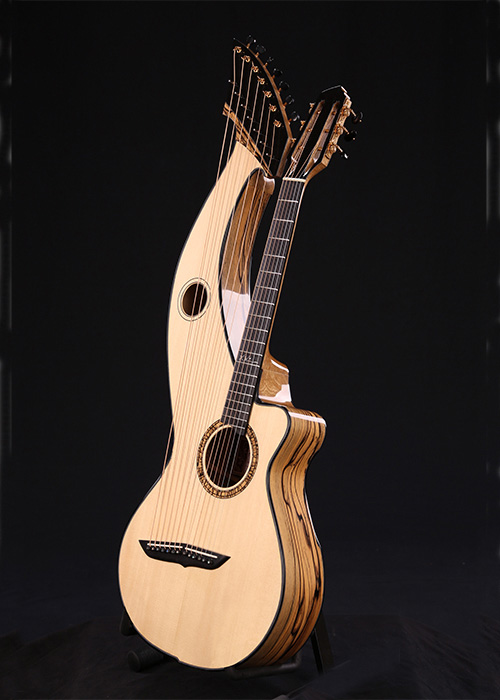
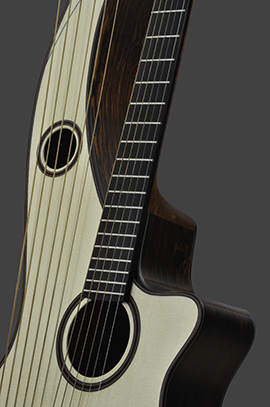
This is the first Kathy Wingert Harp Requinto.
Gregg Miner put out the word that he was rounding up the "what's what" on current builders of smaller harp instruments. That gave me the shove I needed to use some too-small-for-harp guitar woods that I had saved. As he has in the past, Gregg kindly offered examples of historic instruments to examine.
The scale length of just over 21 inches is like a normal guitar capoed at the third fret. The short scale and compact body make it a very accessible instrument. Because of the harp arm and some other tricks, the instrument has a tremendous capacity for its lower registers. It's very happy with standard tuning, Terz or Alt tuning (low string starting on G). Tuned to F#, like a guitar capoed on the 2nd fret, the sub basses would play easily in concert D and A, common keys for a lot of traditional music. For solo? Who cares what key it's really playing in! This is shaping up to be a very versatile instrument. Gregg commented that the tone and sustain of the notes north of the 12th fret were impossibly good.
 View Full Gallery →
 View Full Gallery →